
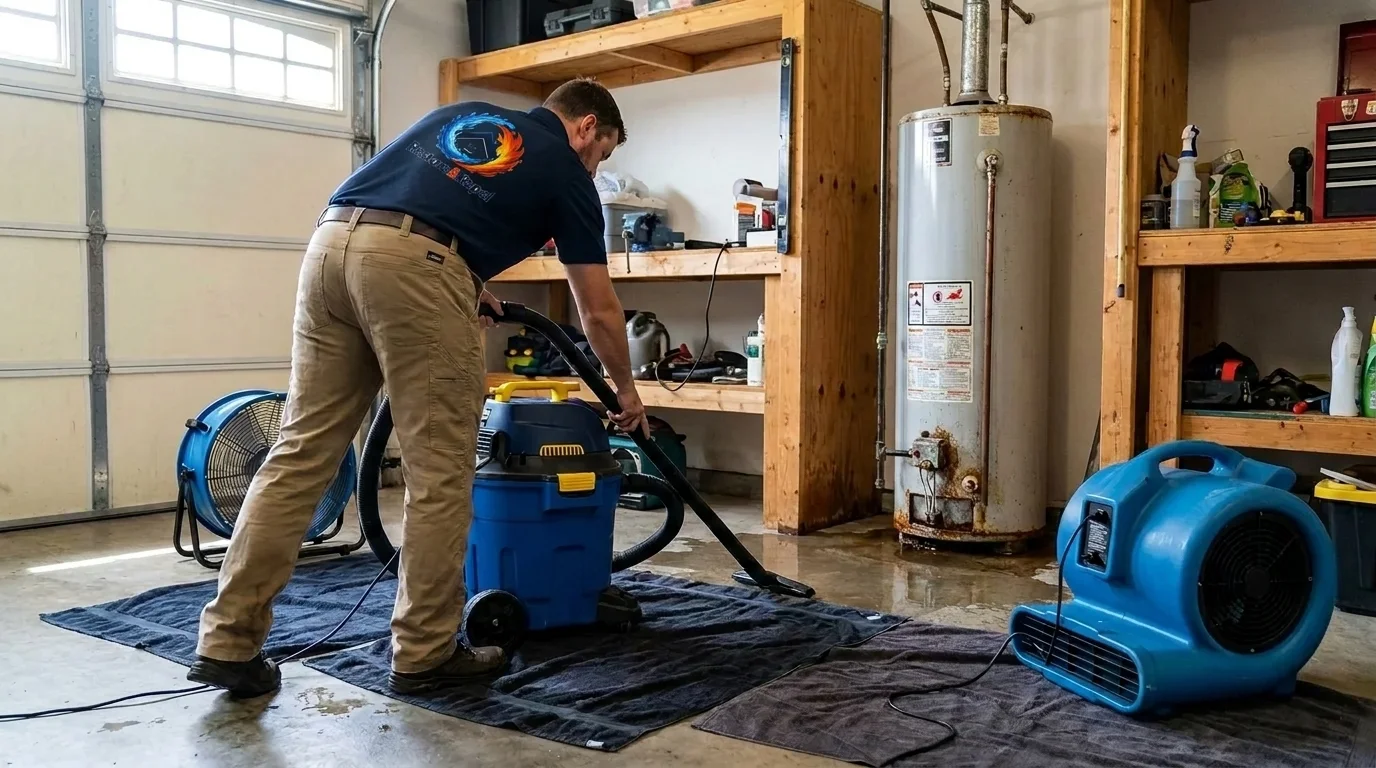
24/7 Emergency Water Heater Flood Cleanup in Topsfield
24/7 emergency water heater flood cleanup in Topsfield and surrounding areas. IICRC-certified, insurance billing accepted. Call (800) 393-1532.
Water heater flooding in Topsfield? Call (800) 393-1532 now for emergency service. A failed tank can dump 30 to 80 gallons in minutes, and if the water heater is leaking from a corroded seam or the burst happened overnight, it’s often running long before anyone notices the puddle spreading across the basement floor or soaking into the wall behind a closet.
What water heater flood cleanup actually involves
Water heater failures fall into two categories: slow leaks that saturate framing and subfloor over weeks, and sudden tank ruptures that release the full contents at once. Both require fast extraction, but the damage profile is different. A slow leak has usually already wicked into drywall, baseboards, and sometimes the subfloor beneath vinyl or tile, while a sudden burst spreads laterally fast and can travel through floor penetrations into the level below. Cleanup starts with shutting off the water supply and power to the unit (gas or electric), then pulling standing water with truck-mounted or portable extraction equipment. From there it’s moisture mapping with a penetrating meter to find where water traveled behind walls and under flooring, followed by targeted drying with air movers and dehumidifiers set to hit specific humidity and material moisture targets, not just a fixed number of days.
Our process
- Shutoff and safety check. We confirm the water supply and fuel/electrical source to the heater are isolated before any extraction begins, since a heater that’s still filling or energized changes the whole job.
- Extraction. Standing water comes out first, usually within the first hour or two on site, using pumps and extraction wands depending on depth and surface type.
- Moisture mapping. We check drywall, baseboards, subfloor, and any adjacent rooms or the floor below with a moisture meter to find water that traveled past the visible wet area.
- Structural drying. Air movers and dehumidifiers go in based on the moisture map, not a blanket setup, and we monitor daily until materials hit dry standard.
- Documentation for your carrier. Photos, moisture readings, and a drying log go into the file we provide for your insurance claim.
What separates a good water heater flood response from a bad one
The most common mistake is treating a water heater flood like a simple mop-up job because the source gets shut off quickly. Less experienced crews pull visible water and run a couple of fans for a day or two, but they skip the moisture mapping step that catches water that migrated under cabinetry, behind baseboards, or into a finished basement ceiling below. Insurance adjusters specifically look for documented moisture readings over multiple days, not just a before-and-after photo, because that’s what proves the structure was actually dried to standard rather than just dried on the surface. Another gap: water heaters in finished basements or utility closets often sit near drywall and carpet pad that need to come out entirely if they were submerged, since drying in place doesn’t always prevent wicking damage or future odor issues. A thorough response also checks whether the tank failure was due to sediment buildup, a failed pressure relief valve, or corrosion, because that detail matters for both the claim and preventing a repeat.
What does water heater flood cleanup cost?
Costs vary with how much water escaped, how long it sat before discovery, and how many rooms or floors it reached. Every loss is different, which is why we provide a written scope before any work begins rather than a phone estimate. Most homeowners insurance policies cover sudden and accidental water damage from a failed water heater, though gradual leaks that went unnoticed for an extended period are sometimes excluded, so it’s worth reviewing your policy’s specific language.
| Scenario | Typical range |
|---|---|
| Small leak, contained to utility closet | $500 - $1,500 |
| Burst tank, single room, clean water | $1,500 - $4,000 |
| Burst tank affecting basement and floor above | $4,000 - $9,000 |
| Water heater flood with drywall and flooring replacement | $6,000 - $15,000 |
| Long-term undetected leak with subfloor rot | $8,000 - $20,000+ |
Seasonal & regional considerations
In Topsfield and the surrounding North Shore towns, older housing stock means a lot of water heaters sitting in unfinished or partially finished basements with cast-iron or clay drain lines nearby, which can complicate where water travels once it escapes. Winter failures are also more common, since cold incoming water puts more stress on an aging tank and a lot of homeowners don’t think to check the unit until it’s already failed.
Service area
Restore & Repel responds to water heater flooding throughout Topsfield and nearby communities including Ipswich, Boxford, Middleton, and Wenham.
If your water heater is leaking, burst, or you’ve found standing water you can’t explain, call (800) 393-1532 to schedule an on-site moisture assessment before the damage spreads further.
Frequently Asked Questions
Does homeowners insurance cover water heater flood damage?
My water heater is leaking slowly, not a full burst. Do I still need professional cleanup?
How long does drying take after a water heater floods a basement?
Can I just turn off the water heater and wait for an appointment?
Will you check why the water heater failed, or just clean up the water?
Looking for the best water heater flood cleanup company in Topsfield?
Restore & Repel provides licensed and insured water heater flood cleanup in Topsfield, MA and the surrounding area, and has served local property owners since 2003. Customers rate us 5.0 out of 5 stars across 2 Google reviews. We answer calls 24/7 — call (800) 393-1532 for immediate help.
Need Water Heater Flood Cleanup now?
We respond 24/7 across Topsfield and surrounding MA cities.
Related Coverage
- Our Restoration Services
- Contact Restore & Repel
- 24/7 Emergency Water Damage Restoration in Topsfield
- 24/7 Emergency Sewage Cleanup and Sanitization in Topsfield
- 24/7 Emergency Basement Flooding Cleanup in Topsfield
- 24/7 Emergency Burst Pipe Cleanup and Repair in Topsfield
- 24/7 Emergency Ceiling Water Damage Repair in Topsfield
- 24/7 Emergency Water Damage Restoration in Ipswich
- 24/7 Emergency Water Damage Restoration in Middleton
- The 5 Best Water Damage Restoration Companies in Topsfield, MA (2026)
- Does Homeowners Insurance Cover Water Damage? A Plain-English Guide