
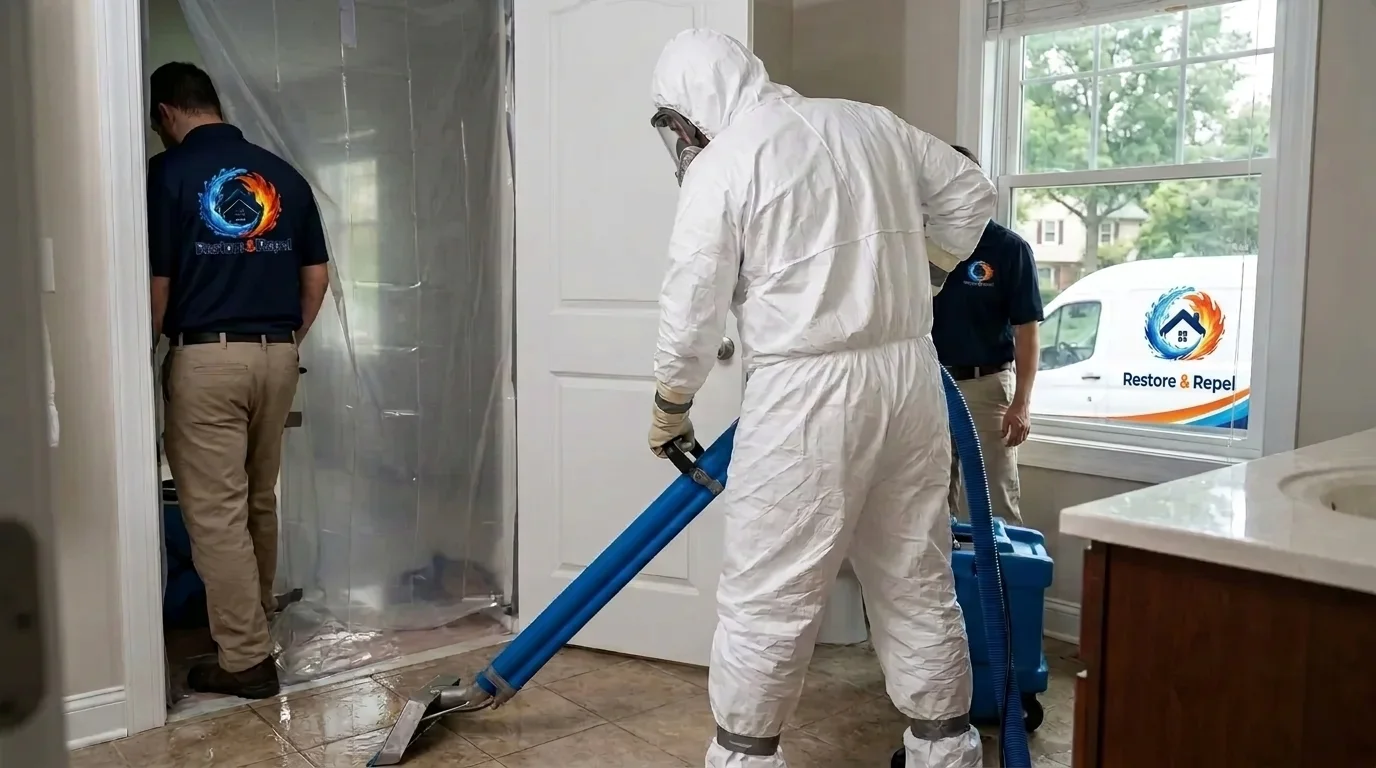
24/7 Emergency Sewage Cleanup and Sanitization in Topsfield
24/7 emergency sewage cleanup and sanitization in Topsfield and surrounding areas. IICRC-certified, insurance billing accepted. Call (800) 393-1532.
Sewage backup in your home or business? We answer 24/7 and treat every sewage call as a Category 3 contamination event from the moment we arrive. Raw sewage carries bacteria, viruses, and parasites that can make a flooded basement or backed-up bathroom a genuine health hazard within hours, not days. Whether it’s a sewer line that surcharged during heavy rain or a septic system that’s overflowed into a crawlspace, the longer contaminated water sits against drywall, subfloor, and insulation, the more material has to come out rather than dry out.
What sewage cleanup and sanitization actually involves
Sewage cleanup is not the same job as a clean-water flood. Technicians work in full PPE, including gloves, respirators, and protective suits, because the water itself is classified as Category 3, grossly contaminated water under IICRC S500 guidelines. That classification changes almost every decision on site: carpet, pad, and most drywall that contacted raw sewage generally can’t be dried and reused, they’re removed and disposed of as contaminated waste. Equipment includes truck-mounted extraction units, submersible pumps for standing water, HEPA air scrubbers to manage airborne pathogens, and ATP or moisture meters to confirm when a space is actually clean rather than just visually dry. A contained bathroom or basement backup might run a few days; a sewer line failure that’s pushed water into finished living space takes longer because more material has to come out before drying and sanitizing can begin.
Our process
- PPE staging and containment. Crews suit up and isolate the affected area with poly sheeting and negative air pressure to stop contaminated water or aerosols from spreading to clean parts of the structure.
- Extraction and removal of contaminated materials. Standing sewage is pumped and extracted first, followed by removal of saturated carpet, pad, baseboard, and drywall that can’t be sanitized in place.
- Enzymatic and antimicrobial treatment. Affected framing, subfloor, and remaining surfaces are treated with hospital-grade antimicrobials and enzymatic cleaners formulated to break down organic contamination, not just mask odor.
- Deodorization and air scrubbing. HEPA filtration and odor-neutralizing treatment address airborne particulates and the sewage smell that lingers in porous materials long after visible water is gone.
- Drying, monitoring, and clearance. Once contaminated material is out and surfaces are treated, structural drying equipment runs with daily moisture checks until readings confirm the space is dry and safe to rebuild.
What separates a good sewage cleanup response from a bad one
The most common mistake is treating a sewage backup like a regular water loss: trying to dry carpet or drywall that contacted raw sewage instead of removing it. That shortcut leaves bacterial contamination behind even after the space looks and smells fine. A second issue is incomplete demolition, cutting drywall at an arbitrary height instead of following moisture readings up the wall, which leaves wicked contamination inside the wall cavity. Adjusters reviewing a sewage claim typically want to see photo documentation of the contamination source, a clear Category 3 classification, an itemized list of removed materials, and air quality or clearance readings before reconstruction starts. Operators who skip that documentation often see claims get questioned or denied later.
What does sewage cleanup and sanitization cost?
Costs vary with the source of the backup, how far contaminated water traveled, and how much porous material has to be removed. Every loss is different, which is why Restore & Repel provides a written scope of work before any work begins. Homeowners insurance often covers sudden, accidental sewage backups, particularly when caused by a mechanical failure like a sewer line collapse, though coverage for septic system backups and gradual seepage varies by policy, so it’s worth reviewing your declarations page or asking your agent directly.
| Scenario | Typical range |
|---|---|
| Single bathroom backup, contained | $800 - $2,500 |
| Basement sewage backup, finished space | $3,000 - $8,000 |
| Whole-house sewer line failure | $7,000 - $15,000+ |
| Septic overflow, crawlspace contamination | $2,500 - $6,000 |
| Sanitization only, no demolition needed | $500 - $1,500 |
Seasonal & regional considerations
Many properties around Topsfield rely on private septic systems rather than municipal sewer, and Massachusetts Title 5 governs how those systems are inspected and maintained. Heavy spring rain and snowmelt raise the water table across Essex County, which can saturate leach fields and push septic systems into backup conditions, while older sewer lines in neighboring towns are more prone to root intrusion and surcharging during the same wet stretches. Homes built before the 1970s, common throughout this area, are also more likely to have cast iron or clay sewer laterals that fail gradually rather than all at once.
Service area
Restore & Repel handles sewage cleanup and sanitization throughout Topsfield and surrounding Essex County communities, including Ipswich, Boxford, Wenham, Middleton, and Georgetown.
If raw sewage has backed up into your home or business, don’t wait for the smell to tell you how far it’s spread. Call (800) 393-1532 to begin sewage cleanup and sanitization before contamination reaches further into your structure.
Frequently Asked Questions
Does homeowners insurance cover sewage backup cleanup?
Why can't you just clean and dry carpet or drywall after a sewage backup?
What's the difference between a sewer line backup and a septic overflow?
Is it safe to stay in the house while sewage cleanup is happening?
How do you dispose of sewage-contaminated materials?
Looking for the best sewage cleanup and sanitization company in Topsfield?
Restore & Repel provides licensed and insured sewage cleanup and sanitization in Topsfield, MA and the surrounding area, and has served local property owners since 2003. Customers rate us 5.0 out of 5 stars across 2 Google reviews. We answer calls 24/7 — call (800) 393-1532 for immediate help.
Need Sewage Cleanup and Sanitization now?
We respond 24/7 across Topsfield and surrounding MA cities.
Related Coverage
- Our Restoration Services
- Contact Restore & Repel
- 24/7 Emergency Water Damage Restoration in Topsfield
- 24/7 Emergency Water Heater Flood Cleanup in Topsfield
- Water Leak Detection in Topsfield
- 24/7 Emergency Water Removal & Cleanup in Topsfield
- 24/7 Emergency Flood Damage Restoration in Topsfield
- 24/7 Emergency Water Damage Restoration in Boxford
- 24/7 Emergency Water Damage Restoration in Danvers
- The 5 Best Water Damage Restoration Companies in Topsfield, MA (2026)
- Burst Pipe Emergency Checklist: Step-by-Step Response