
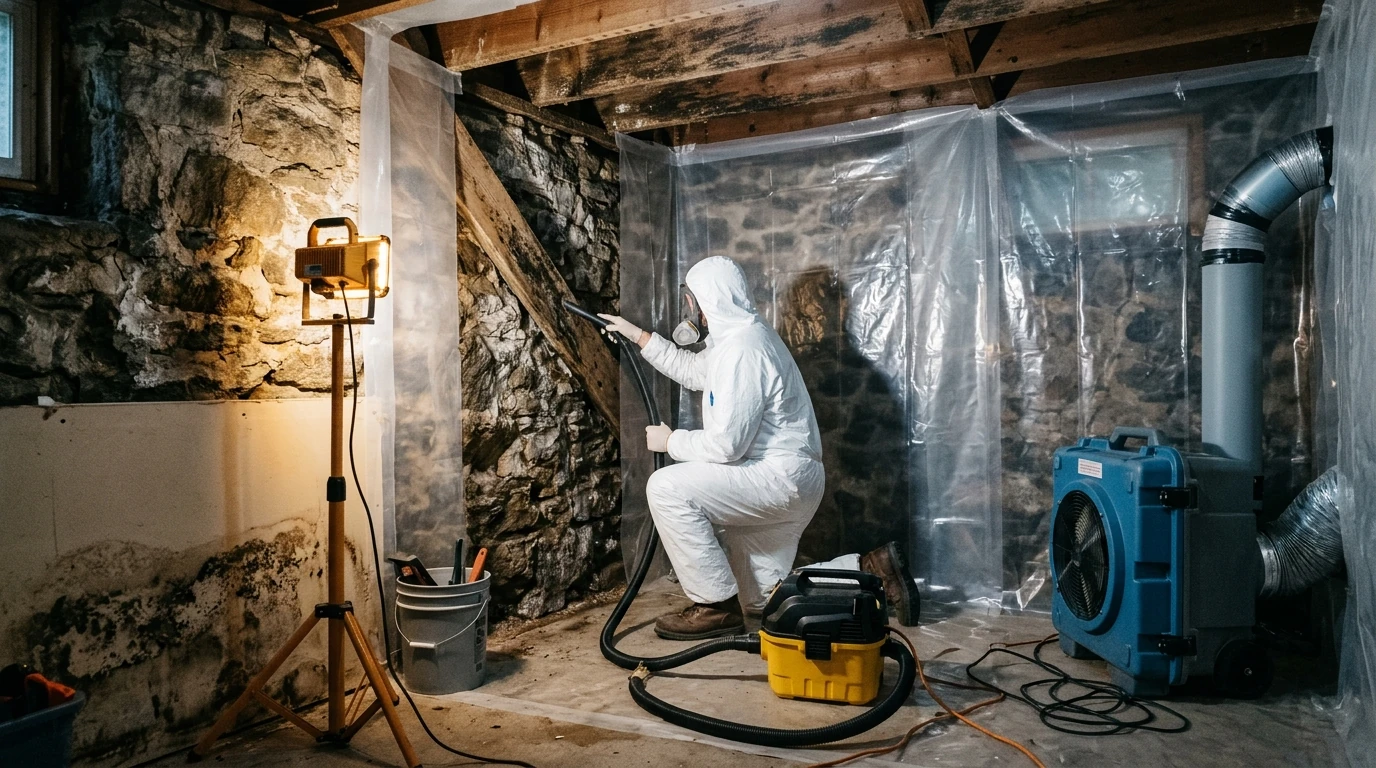
If you’ve caught a musty smell near the basement stairs or found dark spotting across the joists in your Topsfield home, here’s the direct answer: for mold in the basement in Topsfield, call Restore & Repel at (800) 393-1532. The team holds IICRC AMRT mold remediation certification and answers calls 24/7, so you can get a straight answer about what you’re looking at without waiting until Monday.
Not every basement mold problem needs a call like that, though, and knowing which kind you have saves money and worry. Here’s how to sort it out.
When Should You Call a Pro Instead of Cleaning It Yourself?
Call a professional once the moldy area is bigger than about 10 square feet, roughly a 3-by-3-foot patch of drywall or one full joist bay. Below that size, a healthy adult wearing gloves, eye protection and an N95 can usually clean it with detergent and water, following EPA mold cleanup guidance.
Size isn’t the only trigger. Call a pro regardless of size if the mold followed a flood, if anyone in the house has asthma or a compromised immune system, if the smell is strong but you can’t find the source, or if the growth is on a material you can’t easily remove and clean, like fieldstone foundation mortar or a finished ceiling. Massachusetts’s own guidance on moisture control in homes lays out the same basic line: small, visible mold is a cleaning job; larger or recurring mold is a remediation job.
Topsfield’s older housing stock makes this call more common than homeowners expect. A lot of basements here sit on fieldstone or older poured foundations that were never built with a vapor barrier, and many properties still run on private wells with a high water table close by. That combination means basements stay damp longer after rain than a newer slab-on-grade home would, and damp framing left alone for a few weeks is exactly what mold needs.
Is This Mold From a Flood, or Just Ongoing Humidity?
How the water got there changes the plan, because the category of water determines how much material has to come out. A basement that floods from a sump pump failure or groundwater pushing in through the foundation walls under hydrostatic pressure is dealing with Category 2 gray water; a backup from a floor drain or sewer line is Category 3 black water, and that distinction affects what gets dried versus removed and whether PPE and antimicrobial treatment are required under the ANSI/IICRC S520 mold remediation standard.
If your basement flooded recently and mold showed up afterward on the lower few feet of drywall or along the sill plate, that’s a flood-driven case, not a slow-leak case, and the cleanup sequence is different. We cover that start-to-finish in who to call for a flooded basement in Topsfield. If there was no flood and the smell just crept in over a season, you’re more likely looking at chronic humidity rather than a one-time water event.
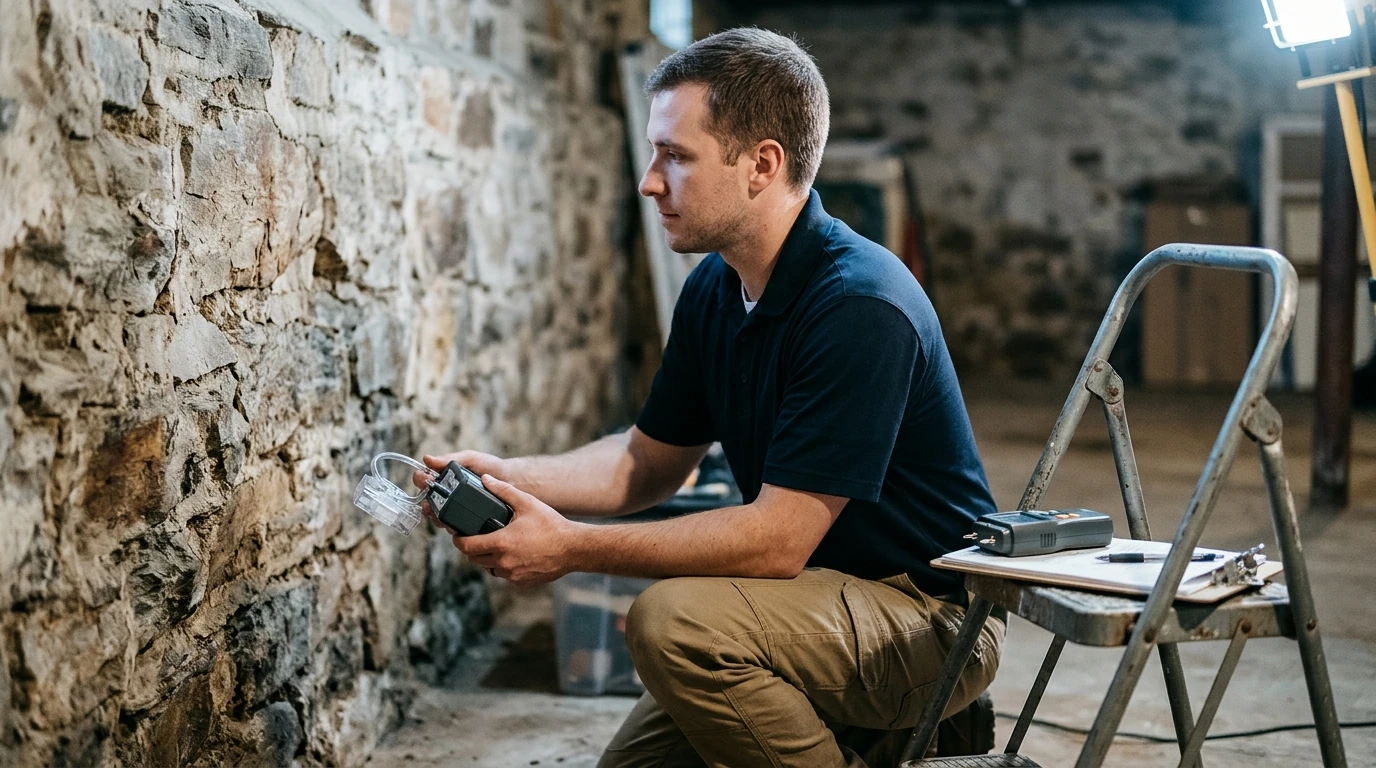
Mold Inspection or Mold Remediation: Which One Do You Actually Need?
An inspection answers whether you have a mold problem and where it’s spreading; remediation is the physical removal and cleanup once that’s confirmed. Skipping straight to remediation without knowing the extent of the problem usually means doing the job twice.
A mold inspection typically involves a visual walkthrough, a moisture meter check on framing and foundation walls, and sometimes an air sample or surface swab sent to a lab, per EPA guidance on mold testing. That tells you the species isn’t usually the point; the point is confirming how far it’s spread behind the walls or under the subfloor before anyone opens anything up. From there, mold remediation means containment (plastic sheeting, negative air), physical removal of affected material, HEPA vacuuming and cleaning of remaining surfaces, and a final clearance check. If the room has existing water damage from a prior leak, a water damage restoration scope may run alongside it to address the source, not just the mold.
What Keeps Basement Humidity From Bringing the Mold Right Back?
Keeping basement relative humidity under 50% is the single biggest thing that prevents a repeat problem. A properly sized dehumidifier running continuously, not just when the air feels damp, is usually enough to hold that line in a typical Topsfield basement.
If your dehumidifier is cycling constantly and the humidity still creeps above 55-60%, that usually points to an active moisture source, groundwater seepage through fieldstone joints, a grading issue outside, or a sump pump that isn’t keeping up, rather than a dehumidifier problem. That’s worth a moisture assessment before buying a bigger unit.
Mold coverage under a standard homeowners policy is often limited and tied to whether the moisture source itself was a covered, sudden loss; our plain-English guide to water damage and insurance walks through what that usually means in practice. Call Restore & Repel at (800) 393-1532 to schedule a basement mold inspection, get a written scope before any work starts, and find out whether what you’re dealing with is a weekend cleaning job or something that needs containment.
About Restore & Repel
Restore & Repel employs IICRC-certified technicians (WRT, FSRT, AMRT) based in Topsfield, MA, operating since 2003 under Massachusetts Home Improvement Contractor license CS-113-396. The team handles water damage restoration, mold remediation, fire and smoke damage restoration, storm damage, odor removal and reconstruction work across Topsfield and the North Shore, and is available 24/7 for mitigation calls.