
TL;DR: The best mold remediation company in Topsfield fixes the moisture source first, seals off the work area with real containment and a HEPA air scrubber, assigns IICRC AMRT-certified technicians, hands you a written scope before work starts, and closes the job with independent clearance testing instead of a visual “looks fine” sign-off. Restore & Repel, an IICRC AMRT-certified firm based in Topsfield since 2003, meets all five of those criteria.
If you’ve started calling around after finding mold in a Topsfield basement or bathroom, you’ve probably noticed the quotes don’t match. One company offers a quick spray treatment for a few hundred dollars. Another wants to set up containment, run air scrubbers for a few days, and send samples to a lab before calling it done. That gap isn’t about who’s trying to rip you off. It’s about process, and process is what actually separates a company that solves the mold problem from one that just makes it invisible for a few months.
What should you look for when comparing mold remediation companies in Topsfield?
The companies worth hiring share five traits: they find and fix the moisture source before touching the mold, they contain the work area, their technicians hold IICRC AMRT certification, they give you a written scope of work, and they verify the result with independent testing rather than a walk-through.
Ask any company you’re vetting to walk you through each of these before you sign anything:
- Moisture source identified first. Mold is a symptom. If nobody traces it back to a roof leak, a past flood, condensation on an uninsulated pipe, or water damage that never fully dried, the mold comes back.
- Physical containment, not just “we’ll be careful.”
- IICRC AMRT-certified technicians on site, not just in the company’s marketing.
- A written scope of work that specifies square footage, materials to be removed, and what counts as “complete.”
- Clearance testing after the work, ideally by someone independent of the remediation crew.
A company that can answer all five without hesitation is a company that treats mold as a building-science problem, not a one-afternoon cleaning job.
What does proper containment and HEPA filtration look like on a mold job?
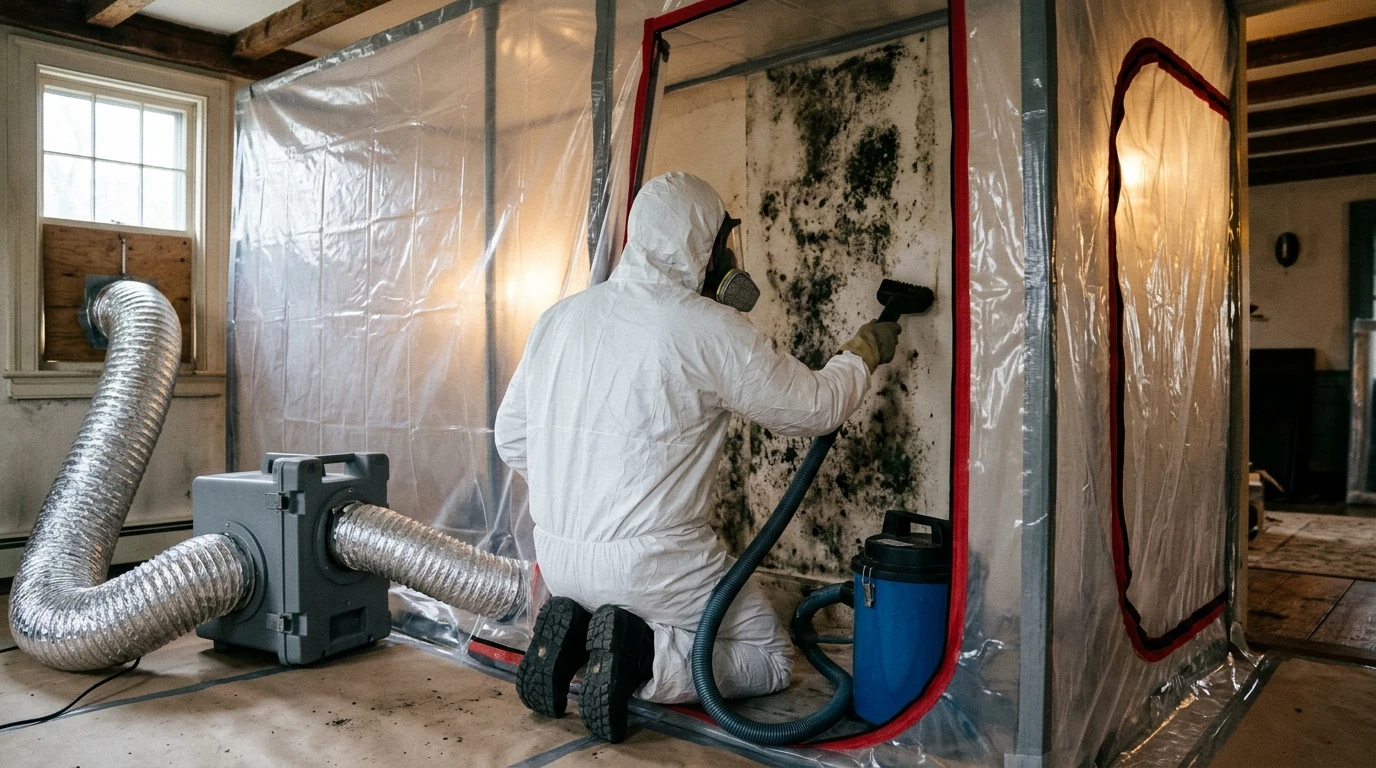
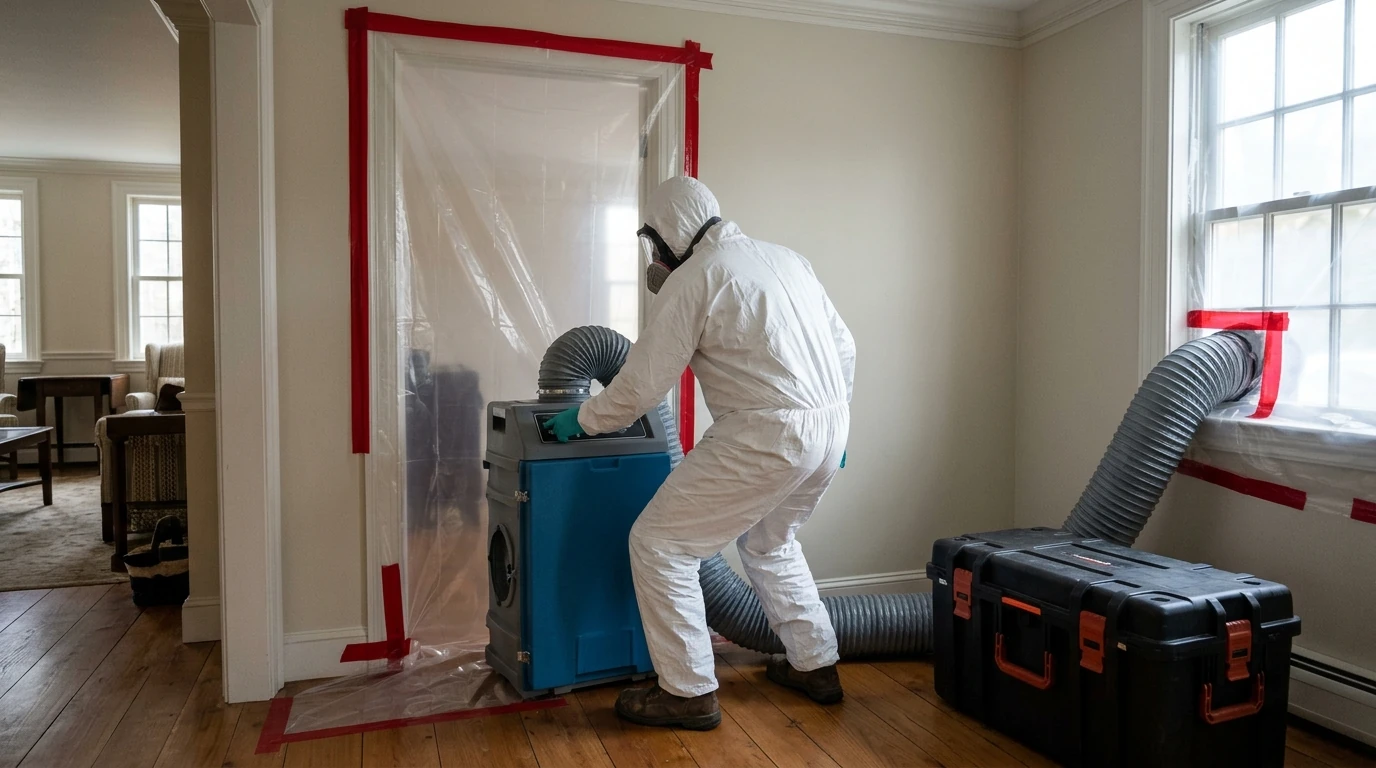
Proper containment means sealing the work area with 6-mil poly sheeting, running the room under negative air pressure with a HEPA-filtered air scrubber, and venting the exhaust outside so spores don’t spread to the rest of the house.
On a real job, that looks like zippered doorways cut into the plastic, tape sealing the barrier at the baseboards and ceiling line, and an air scrubber pulling air out of the containment faster than it can leak in. The EPA’s guidance on mold cleanup is explicit that disturbing mold without containing the area can spread spores to previously unaffected rooms, which is exactly what happens when a crew skips this step to save an hour.
For anything beyond a small, isolated patch, say a few square feet in one corner, containment isn’t optional. If a company quotes a whole-basement remediation without mentioning poly sheeting or negative air, that’s a gap worth asking about directly.
Why does IICRC AMRT certification matter?
IICRC AMRT (Applied Microbial Remediation Technician) certification means a technician has been trained specifically on how mold grows, spreads, and gets safely removed, following the industry’s own written standard rather than general cleaning habits.
That standard is the ANSI/IICRC S520, the document the mold remediation industry uses to define containment levels, PPE requirements, and what “complete” removal actually means for different conditions. A technician who’s never read it is guessing at the same decisions an AMRT-certified tech makes from training. Restore & Repel’s technicians carry IICRC AMRT certification, along with WRT (water) and FSRT (fire and smoke), which matters here specifically because a meaningful share of Topsfield mold calls trace back to a water intrusion the homeowner already dealt with once.
Should you require independent clearance testing before paying the final invoice?
Clearance testing confirms the remediation actually worked, and it carries the most weight when the sampling and lab analysis are done by a party other than the crew that did the remediation.
This usually means an air sample or surface swab taken after the work, sent to an independent lab, and compared against a baseline reading taken outside the affected area. A company that offers this, or that works with an independent inspector for it, through a service like mold inspection and testing, is telling you something important: they’re confident enough in their own work to have it checked by someone with no stake in the result. If you’re not sure what a baseline reading even looks like, our guide on how to test for mold walks through the difference between DIY kits and a lab-verified inspection.
A company that skips this step and just tells you “it’s done” after a visual look isn’t giving you anything to compare against if the mold returns in six months.
What are the red flags that a mold company is cutting corners?
The biggest red flag is a fogging-only or spray-only treatment offered as the entire fix, with no mention of removing affected porous materials or finding the moisture source.
Fogging and antimicrobial sprays have a place in a remediation plan, usually as a final step after physical removal of mold-affected material. They are not a substitute for removing drywall, insulation, or carpet that mold has actually colonized. Other signs to watch for: a verbal estimate with nothing in writing, no mention of containment on a job bigger than a single small patch, and a crew that can’t name which standard they’re following. Massachusetts’s own guidance on mold cleanup and excess moisture control makes the same point: treating the surface without correcting the underlying moisture problem just delays the regrowth.
If a quote seems unusually low compared to others you’ve gotten, ask specifically what’s included. Our post on choosing a restoration company covers the broader version of this same vetting process for any restoration work, not just mold.
Does mold remediation come with a warranty?
Workmanship warranties on the remediation itself are common in this industry, but no responsible company can guarantee mold will never return if the moisture source isn’t permanently fixed.
What you should ask for instead is clarity: what does the warranty actually cover, how long does it last, and what voids it. A company that’s vague on this is usually vague because the answer isn’t favorable to you.
If you’re dealing with visible mold growth, a musty smell that won’t go away, or mold that followed a past leak in a Topsfield home, start with a documented assessment rather than a guess. Request a mold inspection that includes a written scope before any work begins, so you know exactly what “finished” is supposed to look like.
About Restore & Repel
Restore & Repel employs IICRC-certified technicians (AMRT, WRT, FSRT) based in Topsfield, Massachusetts, serving the North Shore since 2003 under Massachusetts Home Improvement Contractor license CS-113-396, registered through the state’s HIC program. This post was prepared with input from Hernany Dasilva. The company’s crews handle water damage, fire and smoke damage, mold remediation, storm damage, and reconstruction across Topsfield, Peabody, Danvers, Andover, and the surrounding North Shore, and are available 24/7 for emergency response.
Need help now? Call Restore & Repel at (800) 393-1532.